A new file is doing the rounds in SEO circles. It’s called llms.txt, and every consultant in your inbox is about to tell you your Sydney business needs one.
Most of the time, you don’t.
Here’s what it actually is, what the evidence actually shows, and whether it’s worth thirty minutes of your day.
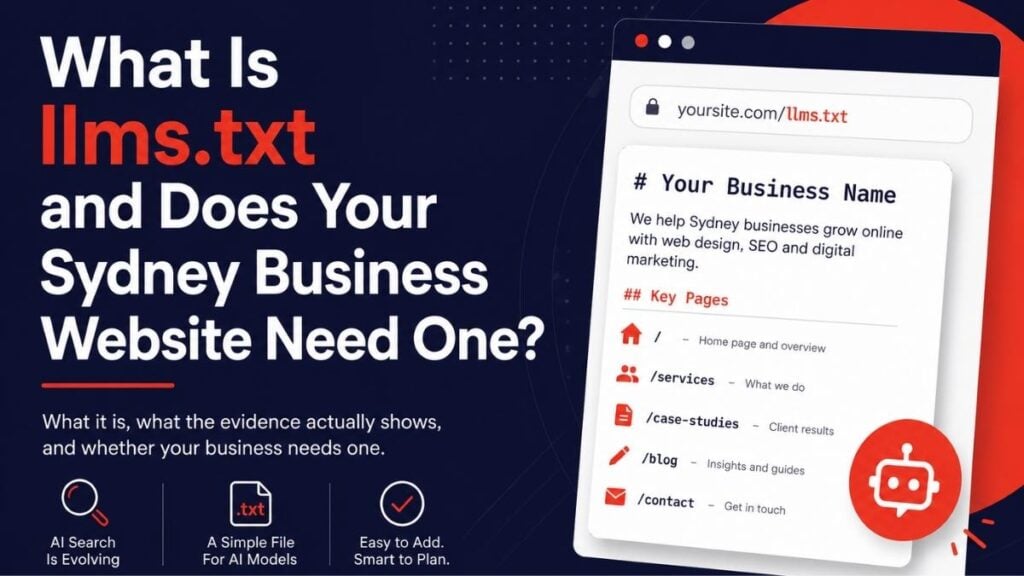
llms.txt is a small markdown file that lives at the root of your website, at yoursite.com/llms.txt. It’s a clean, structured summary of your site, written for AI models to read.
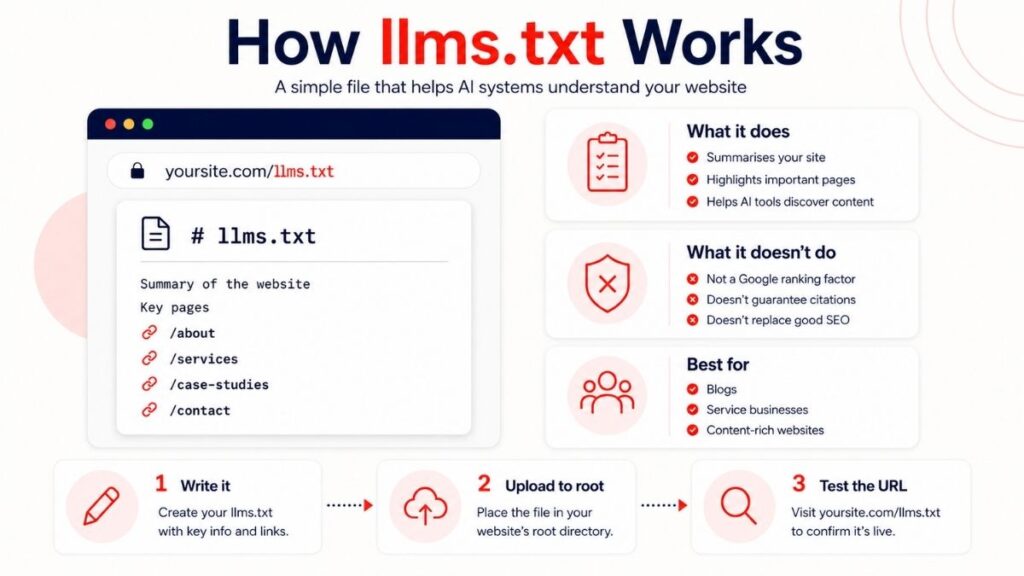
Think of it the way you think about robots.txt for search crawlers, or sitemap.xml for Google. Same idea, different audience. Where robots.txt tells a crawler what it can access, llms.txt tells an AI model what your site is and where the important pages live. The format is plain markdown: an H1 with your site name, a one-paragraph summary, and a list of your key pages with a short note on each. That’s it. No XML, no schema, no plugin required.
The format was proposed by Jeremy Howard at Answer.AI in September 2024, and the full spec lives at llmstxt.org. Search Engine Land covered it as an emerging standard shortly after.
The honest 2026 picture
Here’s the part most articles skip. The AI platforms aren’t actually reading it.
As of mid-2026, no major AI platform treats llms.txt as a ranking signal. SE Ranking analysed 300,000 domains in November 2025 and found the file had no measurable impact on whether a site got cited by ChatGPT, Claude, Gemini, or Perplexity. When they trained a citation prediction model with llms.txt as a variable, removing it actually made the model more accurate. The file added noise, not signal.
About 10% of sites have published one so far, spread evenly across low, mid, and high traffic tiers. The companies that have adopted it tell you who it’s actually for. Stripe. Cloudflare. Anthropic. Zapier. Documentation-heavy SaaS businesses with thousands of pages, where pointing an AI agent at a clean index is genuinely useful. Not Sydney accountants or corner shops.
So why is anyone still talking about it? Two reasons. AI agents and on-demand retrievers from Anthropic and OpenAI can fetch the file when prompted directly, even though routine crawls don’t bother with it. And it costs thirty minutes to add.
It’s a hedge, not a strategy.
Does your Sydney business actually need one?
We get asked about this every week now. The honest answer is the same one we give for most new SEO trends: it depends on what you sell.
You probably want one if:
- You publish content like a blog, guides, case studies, or anything else that earns a Google result
- You sell a considered service that people research before buying
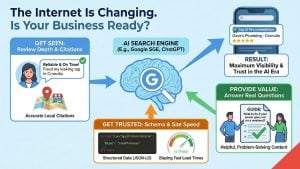
- Your customers are increasingly likely to ask ChatGPT or Perplexity for a recommendation before they Google. More on why that matters in our piece on the shift to AI-first search in Sydney.
You probably don’t need to rush if:
- You’re a foot-traffic business like a cafe, a hairdresser, or a local gym, where Google Maps does the heavy lifting
- You have nothing on your site beyond a homepage and a contact form
- You’re already overdue on more important SEO basics like Core Web Vitals, schema, and a working sitemap
AI search is changing how Sydney customers find local businesses. More on that in our Gemini 3 piece. Being readable to AI is becoming what being readable to Google was in 2010. Early movers don’t win a prize. Late movers spend years catching up.
The same applies to your SEO strategy.
Page one in 2030 belongs to whoever’s writing in 2026. SEO compounds slowly, unfairly, and entirely in favour of whoever started first. That’s the whole pitch.
How to add one
Three steps.
- Write the file. Open a text editor. Add your site name as a heading (
# Your Business Name), a one-paragraph description of what you do, then a list of your most important pages. One line per page, with the URL, a hyphen, and a short summary. - Upload it to your site root. It needs to live at
yoursite.com/llms.txt. On WordPress, the easiest way is via your host’s file manager or FTP. Drop it into the same folder aswp-config.php. - Test it. Visit
yoursite.com/llms.txtin a browser. If the file loads, you’re done.
You can also publish a longer llms-full.txt with the actual page content inlined, for models that prefer the full text. Optional, and overkill for most small business sites.
FAQ
Will llms.txt help me rank in Google?
No. llms.txt is not a Google ranking factor. It’s aimed at large language models, not the traditional search index. Don’t add it expecting an SEO improvement.
Does ChatGPT read my llms.txt?
Not by default. As of mid-2026, ChatGPT and other major AI search products don’t preferentially use llms.txt files. They can fetch one when explicitly prompted, but it isn’t part of their normal retrieval pipeline.
Can llms.txt block AI from training on my content?
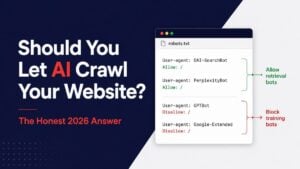
No. It’s a discoverability file, not an access control. To block AI crawlers, use robots.txt with the appropriate user-agent rules. That’s a different post.
Does my WordPress site need a plugin for this?
No. llms.txt is a static markdown file. You just upload it. A few SEO plugins now generate one for you, but it’s not required.
The bottom line
llms.txt isn’t a ranking factor. It’s a discoverability hedge on a standard that hasn’t paid off yet. The companies actually using it are documentation-heavy SaaS businesses, not local Sydney shops.
Add one if you have a content library worth pointing to. Skip it if you don’t. Don’t add it expecting magic, and don’t lose sleep if you never get around to it.
Want someone to make this call for you?
A free site health check covers your hosting, your security, your speed, and yes, whether a llms.txt file would actually help your business. Honest answer either way. No obligation to switch anything. We conduct a quick chat on the phone to see if and how we can help.